
AI Agents for Industrial Customer Service


Implementation of a multi-agent architecture based on large language models for the automated classification, research, and response to complex industrial customer inquiries.

Input

Unstructured customer emails and service tickets from Salesforce.

Output

Fact-checked response drafts with mandatory source citations as preparation for customer service employees.

Goal

Scalable automation of high complex customer service processes while ensuring absolute factual accuracy and data integration.


Introduction


nVent, a global leader in electrical connection and protection solutions with 11,000 employees, manages an extensive portfolio of thousands of specialized technical products. This scale creates a high-density communication environment where customer service teams must navigate extreme technical complexity on a daily basis.


Starting Point


Previously, nVent’s service team performed manual data retrieval across fragmented systems to answer inquiries. This involved cross-referencing ERP and other systems to collect the required data. This manual process resulted in significant response latency, inconsistent quality based on individual employee experience, and a high risk of institutional knowledge loss due to staff turnover.


Challenges


The technical execution faced three primary hurdles. First, critical data was trapped in isolated silos - including CRM, ERP, and Data-warehouse - requiring a solution capable of real-time synchronization and intelligent cross-referencing. Second, the system had to meet rigorous operational demands, integrating seamlessly into the existing CRM workflows of a global team of customer service employees while maintaining performance during peak loads exceeding 1,000 inquiries per day. Finally, the project faced a zero-tolerance policy for hallucinations. In an industrial context, fabricated technical data is a critical liability, meaning the solution required a technical guarantee that every generated statement was backed by a verified internal source.


Solution


The core of the nVent SKI solution is a sophisticated LLM-based orchestration layer designed to replicate the multi-step analytical process of a human technical expert. This architecture moves beyond simple chatbots by deploying a specialized multi-agent system that treats each customer inquiry as a complex task. 

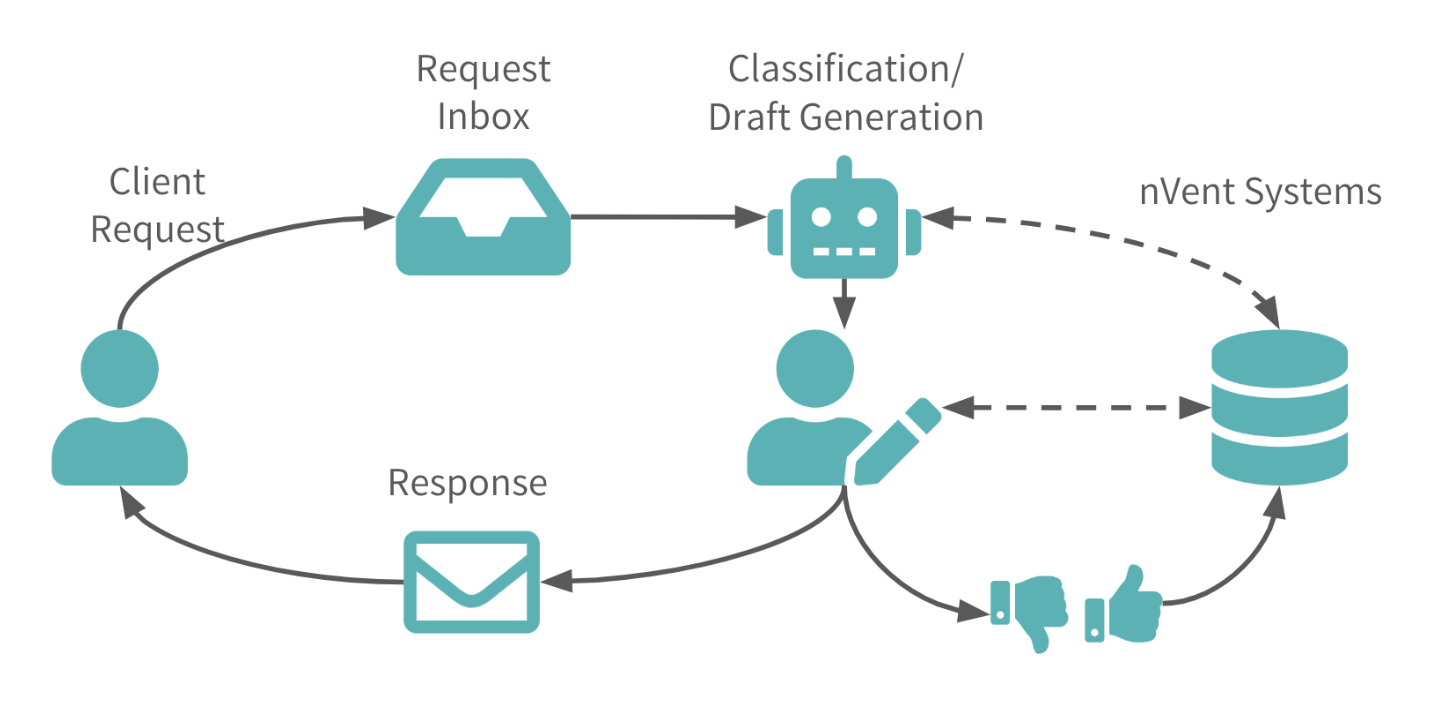
When an unstructured request enters the system via CRM, a central AI orchestrator immediately classifies the intent and routes the task to a fleet of specialized agents, each possessing "expertise" in a specific data domain.

  • The Categorization Agent first performs a deep linguistic analysis of the customer’s intent. Based on this classification, Agents triggers real-time data retrieval from ERP to provide precise status updates. 

  • Simultaneously, another Agent navigates the complex internal DAM/PIM systems. It utilizes a custom-built Retrieval-Augmented Generation (RAG) framework to scan various technical documents. 

  • Finally, a Synthesis Agent aggregates these disparate data points - ranging from technical specifications to real-time logistics - into a coherent, professional response draft. This draft is uniquely tailored to match the specific tone and historical communication style of the assigned customer care agent, ensuring brand consistency.

To meet nVent's rigorous standards for industrial reliability, the architecture enforces a strict data-anchoring policy. Every generated statement is automatically linked to a specific citation, providing 100% traceability back to the source document or database entry. Before the draft is presented to the Customer Care employee, a secondary LLM-as-a-Judge component performs an automated quality audit. This auditor checks the response for factual accuracy against the retrieved data and ensures the tone meets corporate guidelines. This multi-layered verification process effectively eliminates hallucinations, eventually allowing all customer service employees to trust and approve generated email drafts with high confidence.

Graphic 1: Conceptual overview of nVent’s agentic solution

Results


The pilot implementation of nVent’s agentic AI solutions clearly demonstrates the potential to transform the customer service department into a highly effective customer-experience focused organization.

  • threshold of incoming customer emails, eligible for automatic, source-anchored response generation, is being met.

  • To ensure quality during the pilot phase, employees are currently required to review all generated responses and verify the included source citations.

  • Automation of research and writing tasks is targeted to achieve a 95% reduction in initial draft processing time, contingent upon achieving full semantic standardization.

  • Strict data-anchoring ensures 100% traceability and source-based answers, eliminating hallucinations.

  • The first wave rolled out to a European team, establishing the model for scaling globally to all Customer Support employees and securing institutional knowledge.


Technical Background


The solution is built on a modern, cloud-native stack deployed entirely within nVent’s AWS environment to meet strict security requirements. We utilized Python and FastAPI to build modular microservices, orchestrated via LangGraph and LangChain. The system architecture follows hexagonal architecture and domain-driven design (DDD) principles to ensure the platform remains maintainable and decoupled from external infrastructure. For deployment, we utilized Docker containers on AWS Fargate for serverless scaling, with Snowflake serving as the central data backbone. Advanced monitoring is provided by Langfuse, which allows for granular tracing of prompts and continuous quality control.

Related projects