
Impact of higher-order exchange on the lifetime of skyrmions and antiskyrmions
by Hendrik Schrautzer, Moritz A. Goerzen, Bjarne Beyer, Soumyayouti Haldar, Pavel F. Bessarab, Stefan Heinze
Year:
2026
Publication:
npj Computational Materials
Abstract:
Reliable control of skyrmion lifetime is essential for realizing spintronic devices, yet the role of higher-order exchange—which can lead to skyrmion stabilization—remains largely unexplored. Here we calculate lifetimes of isolated skyrmions and antiskyrmions at transition-metal interfaces based on an atomistic spin model that includes all fourth-order exchange terms. Within harmonic transition-state theory, we evaluate both energetic and entropic contributions and find substantially enhanced lifetimes when higher-order exchange is included. The four-spin four-site interaction raises the energy barrier and lowers the curvature of the energy landscape at the collapse saddle point, increasing the pre-exponential factor. We show that skyrmions and antiskyrmions can remain thermally stable even without Dzyaloshinskii-Moriya interaction (DMI), and that tuning the four-spin term by a small amount modulates the prefactor over orders of magnitude. Our results identify higher-order exchange as a promising route to stabilize topological magnetic textures—in particular in systems lacking DMI—and to engineer their thermally activated decay.
Link:
Read the paperAdditional Information
Brief introduction of the dida co-author(s) and relevance for dida's ML developments.
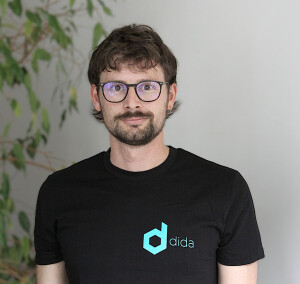
Hendrik Schrautzer (PhD)
Hendrik studied physics in Kiel, focusing on theoretical physics and computational simulations of nanomagnetism. During his doctoral studies in Iceland, his work involved the development of efficient optimization algorithms for high-dimensional energy surfaces in magnetic materials. At dida, Hendrik contributes his expertise as a machine learning scientist.