

Generative Sliced MMD Flows with Riesz Kernels
by Johannes Hertrich, Christian Wald, Fabian Altekrüger, Paul Hagemann
Year:
2024
Publication:
International Conference on Learning Representations (ICLR)
Abstract:
ABSTRACT Maximum mean discrepancy (MMD) flows suffer from high computational costs in large scale computations. In this paper, we show that MMD flows with Riesz kernels K(x,y) = −∥x−y∥r, r ∈ (0,2) have exceptional properties which allow their efficient computation. We prove that the MMD of Riesz kernels, which is also known as energy distance, coincides with the MMD of their sliced version. As a consequence, the computation of gradients of MMDs can be performed in the one-dimensional setting. Here, for r = 1, a simple sorting algorithm can be applied to reduce the complexity from O(MN+N2)to O((M+N)log(M+N))for two measures with M and N support points. As another interesting follow-up result, the MMD of compactly supported measures can be estimated from above and below by the Wasserstein-1 distance. For the implementations we approximate the gradient of the sliced MMD by using only a finite number P of slices. We show that the resulting error has complexity O( \sqrt(d/P) ), where d is the data dimension. These results enable us to train generative models by approximating MMD gradient flows by neural networks even for image applications. We demonstrate the efficiency of our model by image generation on MNIST, FashionMNIST and CIFAR10.
Link:
Read the paperAdditional Information
Brief introduction of the dida co-author(s) and relevance for dida's ML developments.
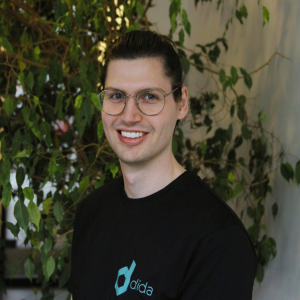
Fabian Altekrüger (PhD)
During his mathematics studies at TU Berlin, Fabian focused on functional analysis. In his subsequent doctoral research, he worked on the regularization and solution of Bayesian inverse problems in mathematical image processing, combining mathematical methods with neural networks. In this context, Fabian developed and applied conditional generative models, always with an emphasis on the stability and robustness of the methods. At dida, he contributes his skills as a machine learning scientist.