

NeurIPS 2026: Lorenz Richter co-authors paper on learning Schrödinger bridges
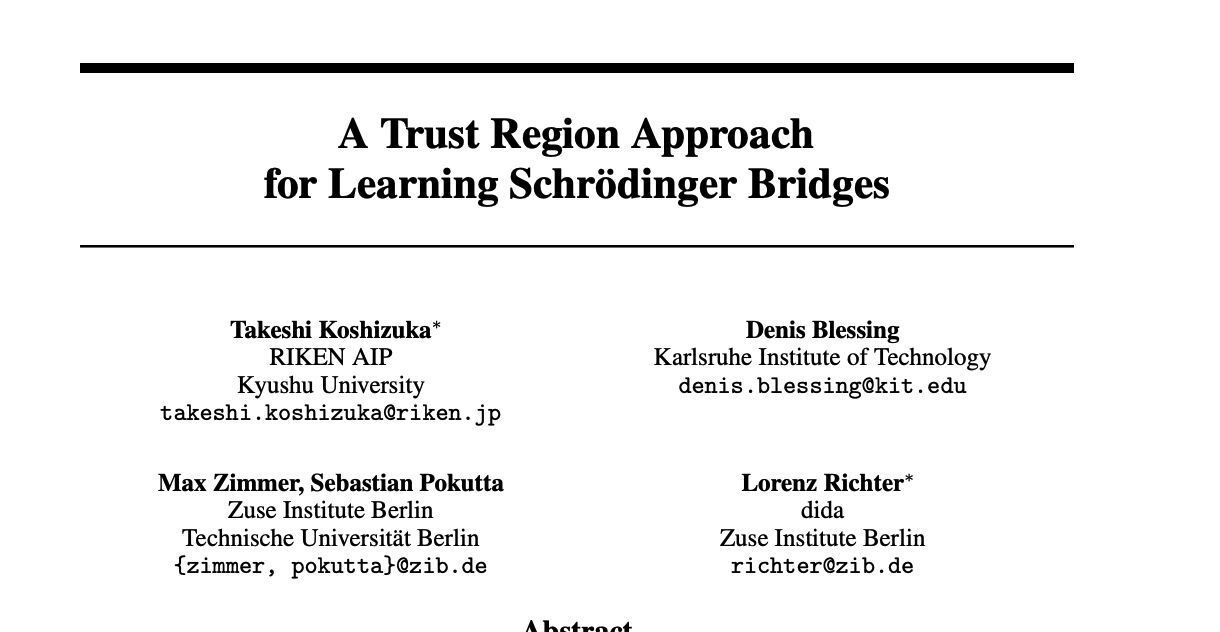
Our founder Lorenz Richter (dida, Zuse Institute Berlin) has co-authored a paper accepted at NeurIPS 2026: “A Trust Region Approach for Learning Schrödinger Bridges”. His co-authors are Takeshi Koshizuka (RIKEN AIP, Kyushu University), Denis Blessing (Karlsruhe Institute of Technology) as well as Max Zimmer and Sebastian Pokutta (Zuse Institute Berlin, Technische Universität Berlin).
The problem: sampling from unnormalized densities
Many problems in the natural sciences require samples from a probability distribution that is only known up to a normalizing constant. A typical example is the distribution of molecular configurations defined by an energy function. Schrödinger bridges are a strong tool for this task. The standard solver, iterative proportional fitting (IPF), tends to be unstable in practice and often collapses onto a few modes of the target distribution.
The approach: a trust region for IPF
The paper proposes to keep every update within a fixed Kullback-Leibler (KL) distance of the current iterate. This trust region turns IPF into mirror descent with an adaptive step size. The result is more stable training and less mode collapse. The authors demonstrate this on benchmarks ranging from Many-Well potentials to alanine dipeptide, a standard test molecule in molecular simulation.
Meet Lorenz in Sydney
Lorenz will be at NeurIPS 2026 in Sydney. If you want to discuss Scientific Machine Learning with him, get in touch.
The paper is available on arXiv.