

Sequential Controlled Langevin Diffusions
von Junhua Chen, Lorenz Richter, Julius Berner, Denis Blessing, Gerhard Neumann, Anima Anandkumar
Jahr:
2025
Publikation:
International Conference on Learning Representations (ICLR)
Abstrakt:
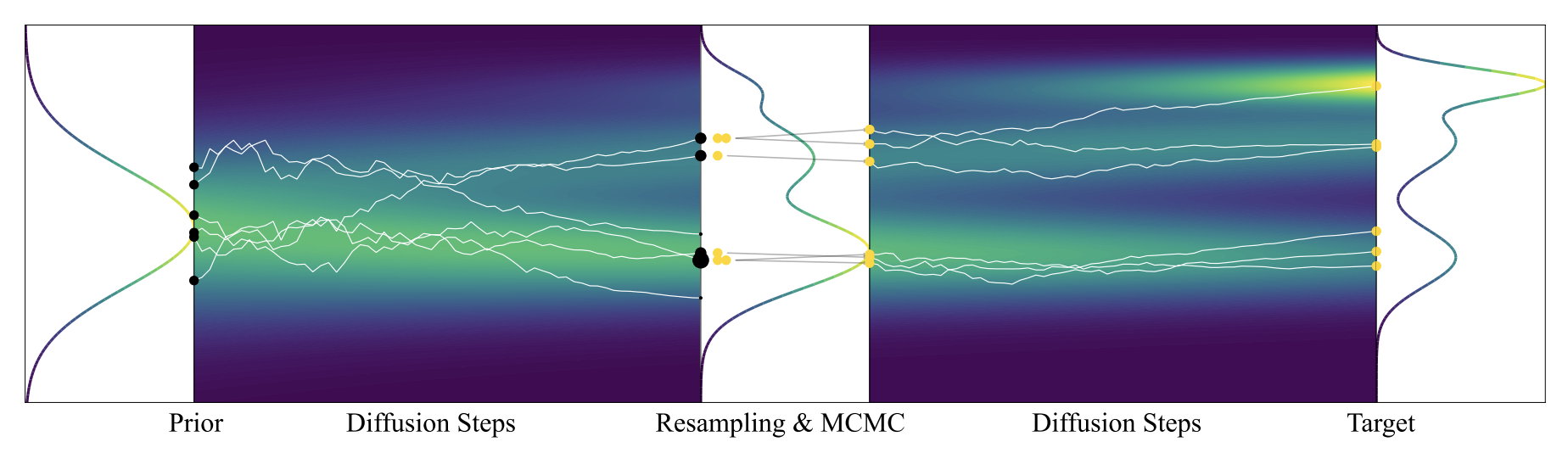
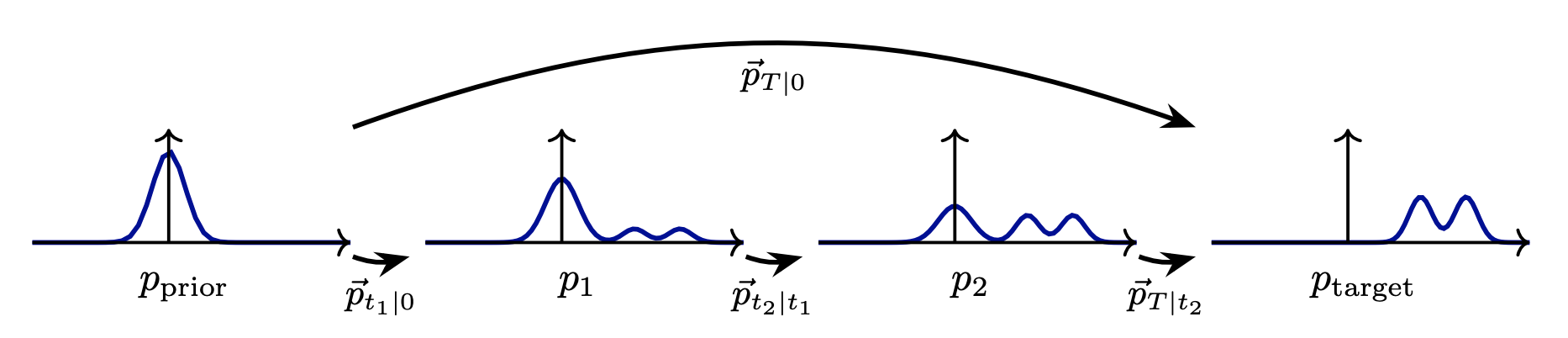
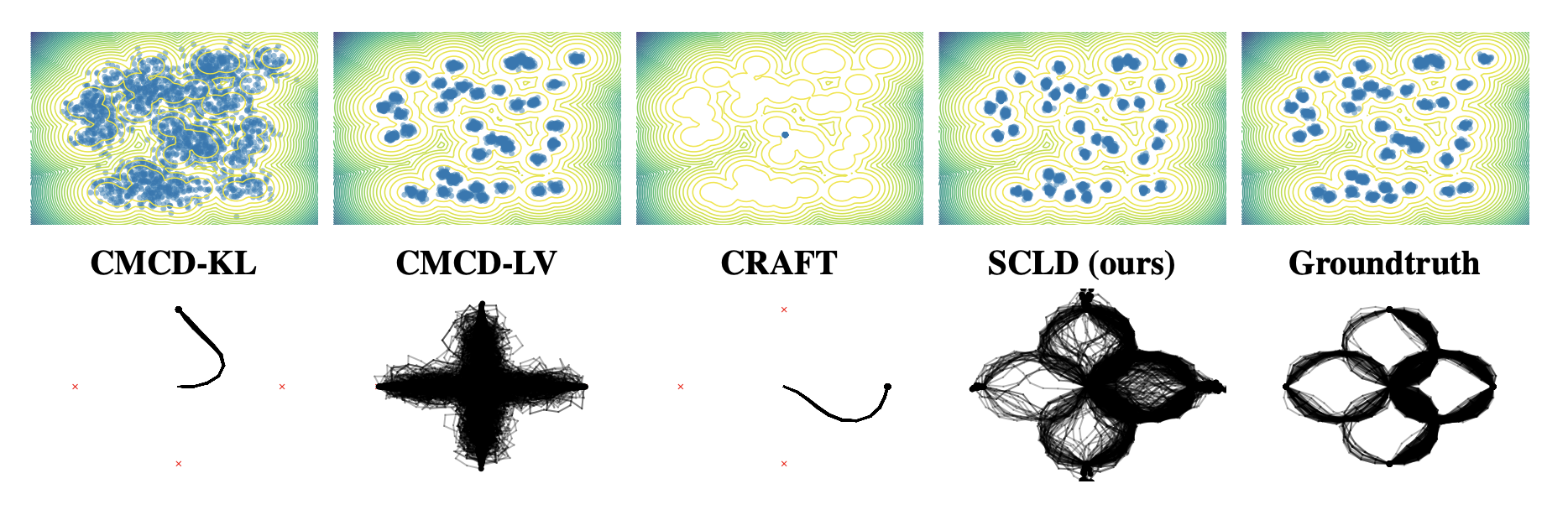
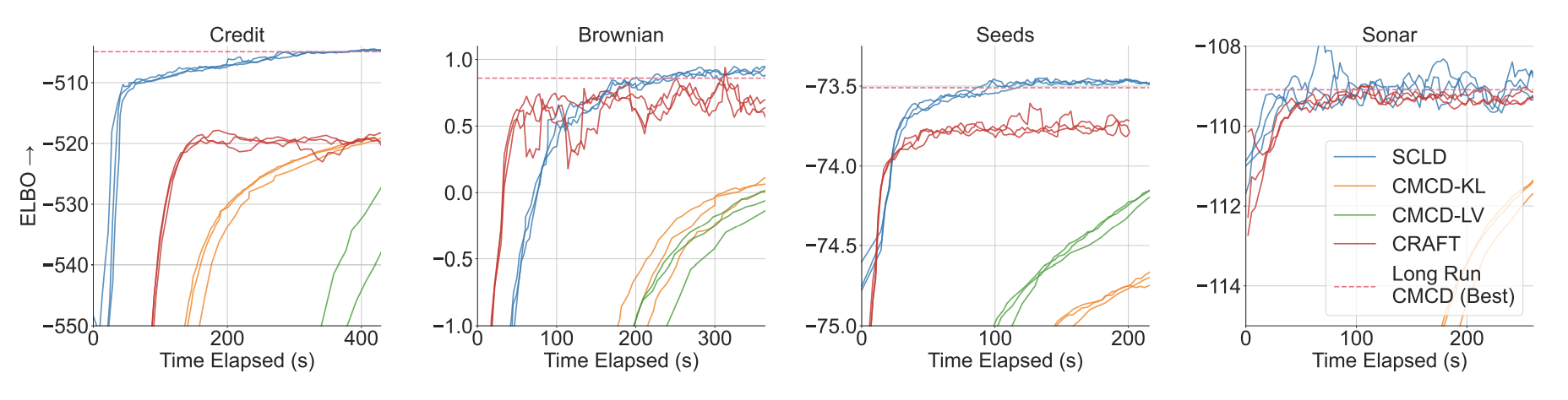
An effective approach for sampling from unnormalized densities is based on the idea of gradually transporting samples from an easy prior to the complicated target distribution. Two popular methods are (1) Sequential Monte Carlo (SMC), where the transport is performed through successive annealed densities via prescribed Markov chains and resampling steps, and (2) recently developed diffusion-based sampling methods, where a learned dynamical transport is used. Despite the common goal, both approaches have different, often complementary, advantages and drawbacks. The resampling steps in SMC allow focusing on promising regions of the space, often leading to robust performance. While the algorithm enjoys asymptotic guarantees, the lack of flexible, learnable transitions can lead to slow convergence. On the other hand, diffusion-based samplers are learned and can potentially better adapt themselves to the target at hand, yet often suffer from training instabilities. In this work, we present a principled framework for combining SMC with diffusion-based samplers by viewing both methods in continuous time and considering measures on path space. This culminates in the new Sequential Controlled Langevin Diffusion (SCLD) sampling method, which is able to utilize the benefits of both methods and reaches improved performance on multiple benchmark problems, in many cases using only 10% of the training budget of previous diffusion-based samplers.
Link:
Read the paperAdditional Information
Brief introduction of the dida co-author(s) and relevance for dida's ML developments.

Dr. Lorenz Richter
Aus der Stochastik und Numerik kommend (FU Berlin), beschäftigt sich der Mathematiker seit einigen Jahren mit Deep-Learning-Algorithmen. Neben seinem Faible für die Theorie hat er in den letzten 10 Jahren diverse Data Science-Probleme praktisch gelöst. Lorenz leitet das Machine-Learning-Team.