

Optimal control of mean field equations with monotone coefficients and applications in neuroscience
von Antoine Hocquet, Alexander Vogler
Jahr:
2021
Publikation:
Applied Mathematics and Optimization
Abstrakt:
We are interested in the optimal control problem associated with certain quadratic cost functionals depending on the solution X = Xα of the stochastic mean-field type evolution equation in Rd
dXt = b(t, Xt,L(Xt), αt)dt+σ (t, Xt,L(Xt), αt)dWt , X0 ∼ μ (μ given), (1)
under assumptions that enclose a system of FitzHugh–Nagumo neuron networks, and where for practical purposes the control αt is deterministic. To do so, we assume that we are given a drift coefficient that satisfies a one-sided Lipschitz condition, and that the dynamics (2) satisfies an almost sure boundedness property of the form π(Xt) ≤ 0. The mathematical treatment we propose follows the lines of the recent monograph of Carmona and Delarue for similar control problems with Lipschitz coefficients. After addressing the existence of minimizers via a martingale approach, we show a maximum principle for (2), and numerically investigate a gradient algorithm for the approximation of the optimal control.
Link:
Read the paperAdditional Information
Brief introduction of the dida co-author(s) and relevance for dida's ML developments.
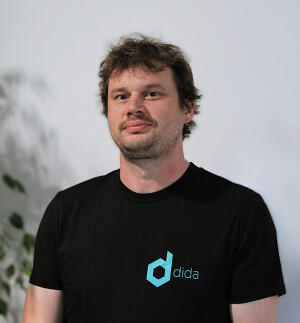
Dr. Antoine Hocquet
Antoine hat an der École Polytechnique in angewandter Mathematik promoviert und war acht Jahre lang als Postdoktorand an der TU Berlin tätig, wo er sich mit stochastischen partiellen Differentialgleichungen, der Rough-Paths-Theorie und Mean-Field-Modellen befasste – Bereichen, in denen die strenge Mathematik versucht, komplexe Phänomene der realen Welt zu erklären. In dieser Zeit verfasste er mehr als 15 peer-reviewed Publikationen und hielt Lehrveranstaltungen für Graduierte in numerischer Analysis und stochastischen Methoden. Angezogen von der Herausforderung, Mathematik nicht nur zu betreiben, sondern sie auch nutzbar zu machen, wandte er sich anschließend dem Machine Learning zu und baute ein Portfolio auf, das Image Segmentation, Reinforcement Learning und LLM-gestützte Dokumentenverarbeitung umfasst. Bei dida arbeitet er als Machine Learning Scientist.